

AI Hiring Discrimination
The use of Artificial intelligence (AI) and Applicant Tracking Systems (ATS) to filter out experienced candidates is so commonplace that the bias and harm are overlooked. Big corporations to small nonprofits use ATS that reject experienced candidates by default. This isn’t a technical bug. The systems can be specifically calibrated to screen out people based on years worked and college graduation date. Many companies embrace AI filtering as an efficient and economical tool to save recruiters time and reduce labor costs. When everyone is using biased systems, the illegality is dismissed.
Bias Coded In
A recent Stanford University research study details how AI hiring tools systemically reject applicants based on demographics not qualifications. The study focused on racial bias, but gender and age are filtered as well. A few ATS vendors control how millions of applicants are flagged and excluded, which follow a candidate across job applications for different companies. Despite the inherent discrimination in the AI-hiring systems, “they are pervasively adopted, highly consequential, and opaque to the public.”
Virtual Evasion
By using AI, companies sidestep the state and federal laws prohibiting discrimination in hiring with impunity. While scholars and lawyers warn of the potential liabilities of AI’s ethical breaches, the consequences thus far have been minor. The ubiquity of the practice and automated nature of the hiring filters hide the bias. Candidates of a certain age (and race or gender) are removed using innocuous data categories, and no one is the wiser.
Underhanded Recruitment
AI recruitment tools have become an HR office standard, achieving the cost cutting goals of the boss while keeping HR’s hands clean. In most large corporations, the initial recruitment screening is done by AI and then sent to an offshore recruiting vendor, where low-paid staff follow strict directives and do not evaluate the ATS resumes delivered. When a list of final candidates reaches the corporate HR office, the filtering fix is in.
HR professionals are realizing they’ve lost control and are sounding the alarm about the potential for AI employment malpractice. Recruiters are on the frontlines and see that AI-generated filters, such as age limits and racial exclusions, are a losing proposition for the company. ATS may be an effective hiring tool, but only if deployed and monitored appropriately by HR professionals.
Disadvantaged Job Seekers
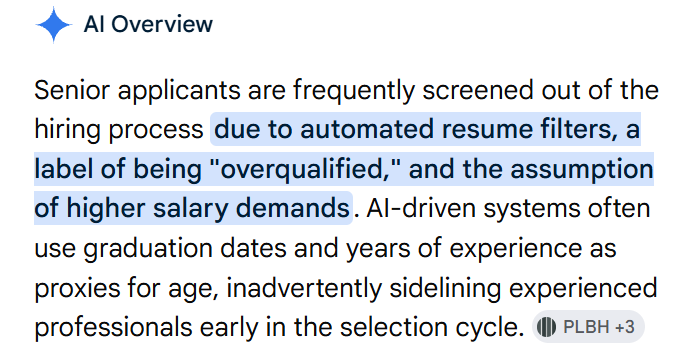
The reaction by mature candidates who are excluded from hiring is to try to beat the algorithm. There’s a cottage industry on Linkedin and elsewhere offering tips on how people over 40 can avoid AI traps, edit resumes to cheat ATS filters, and work around the automated barriers that stop resumes from reaching a hiring manager’s in box. It’s a sad acknowledgement that the system is rigged. Googling “senior applicants screened out by AI” delivers an ironic AI response that admits to AI biased screening.
Wage Suppression
The real reason companies use AI tools to exclude experienced candidates, of course, is to cut costs while avoiding legal scrutiny. Some executives don’t want to pay experienced people market rates if they can find cheap entry-level and junior labor. The ABA advocates for bias audits of AI, but companies are embolden because job seekers cannot easily prove intentional discrimination. Software algorithms are impersonal, not publicly available, and rarely subject to legal inquiry. Companies use AI tools because they work—if the goal is to replace higher paid workers with lower paid workers.
Legal Remedy
The lack of AI-specific employment regulations provide cover, despite the research that demonstrates wide-scale demographic bias. Without high-profile lawsuits and prosecutions against AI hiring filters, companies will continue the practice. Afterall, if everyone’s doing it and no one’s getting in real trouble, excluding an entire class of people from employment becomes routine. At this point, only lawmakers can reign in automated employment discrimination as the civil rights violation it is.
Fair Play
AI age screening is a byproduct of a myopic scheme to reduce personnel costs—at all costs. Executives would better serve their bottom lines by objectively evaluating staff performance not merely salaries. A blend of senior and junior staff of all genders and ethnicities has been the winning formula from the beginning of human work. Apprentices learn from journeymen, and together they add value.
Everyone is negatively impacted by biased hiring practices that treat experience as a liability. AI screening that secretly drafts only young applicants (or white or male) is blatantly unfair competition. We should all refuse to play this losing game.